



Beyond Black and White: The Evolution of Color Night Vision Technology
For decades, nighttime surveillance footage looked identical across every system: a grainy, eerie, monochromatic world illuminated by glowing red infrared beads. While infrared (IR) night vision is highly effective at cutting through pitch darkness, it strips away critical forensic data. If an intruder breaks into a business, telling the police that the suspect was wearing a "grey jacket" doesn't help much when the jacket was actually bright red. Let's look at how modern sensor innovations are permanently illuminating the dark.
The Breakdown
1. Traditional Infrared (IR) Surveillance
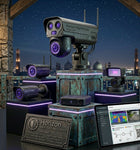
Traditional night vision uses built-in IR LEDs to flood an area with infrared light that is invisible to the human eye but completely visible to the camera's sensor. The drawback is that the resulting video is strictly grayscale, losing key identifiers like hair color, clothing color, or vehicle paint shades.
2. Large-Aperture Sensors & Ambient Light Amplification
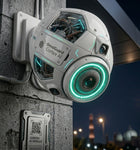
Modern high-end security cameras utilize specialized sensors (like Sony’s Starvis line) combined with massive physical lens apertures ($f/1.0$ or $f/1.2$). These lenses act like light buckets, catching every stray photon of ambient light from streetlamps, the moon, or porch fixtures. The advanced sensor amplifies this minimal light to produce crisp, full-color daytime-looking images in near-total darkness.
3. Dual-Light Hybrid Systems
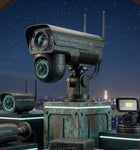
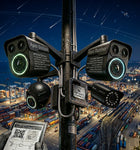
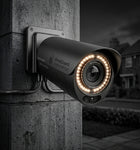
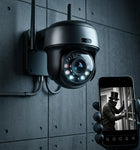
The newest trend combines both worlds. The camera remains in discreet, invisible IR mode during quiet hours. However, the moment its onboard AI detects a human shape, it automatically triggers a warm, bright visible LED spotlight. This instantly scares off the intruder while giving the camera enough light to capture the event in vivid, full-color high definition.
Conclusion
When selecting a security system, don't settle for legacy IR technology. Insist on cameras featuring advanced low-light color sensors or intelligent hybrid spotlight systems. The ability to give law enforcement an exact color description is often the difference between a cold case and an arrest.